

Wearable Technology Market Size to Grow from USD 272.80 Billion in 2026 at a 15.85% CAGR
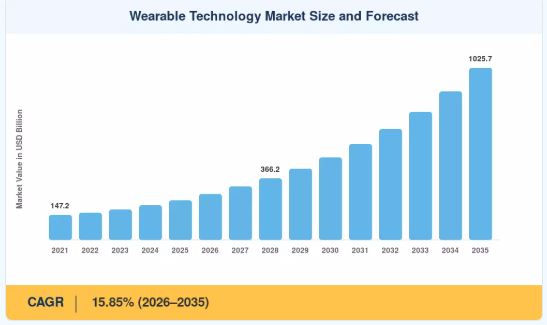
Wearable Technology Market
Wearable Technology Market: Wearable technology is transforming healthcare, fitness, and consumer electronics through smart, connected devices that enable real-time monitoring.”
SHANGHAI, SHANGHAI, CHINA, July 29, 2026 /EINPresswire.com/ -- The Global Wearable Technology market reached an estimated USD 235.50 billion in 2025 and is projected to open the forecast window at roughly USD 272.80 billion in 2026, climbing to USD 1,025.70 billion by 2035 at a CAGR of 15.85%. Two forces anchor this trajectory: the U.S. Food and Drug Administration's expanding De Novo pathway for AI-enabled medical wearables, which cleared a record 47 devices in 2024 alone, and enterprise capital expenditure on augmented-reality headsets for frontline operations, which exceeded USD 9.2 billion globally in the same year both of which push wearables from lifestyle accessories to clinically and operationally essential devices. — Market Research Future (MRFR)
The market's 15.85% CAGR reflects the convergence of FDA and EU regulatory clearances (~2.8% CAGR impact), enterprise AR/MR headset deployments (~2.3%), solid-state battery breakthroughs (~2.1%), and government digital health subsidies in emerging economies (~1.5%) accelerating across the world's largest consumer electronics and healthcare markets simultaneously.
Isolated fitness trackers and single-purpose monitors are increasingly being displaced by fully integrated, sensor-rich platforms that blend biometric capture, edge AI inference, and cloud analytics in a single wrist-worn or ear-worn housing. Investment in solid-state and silicon-anode battery chemistries is increasingly focused on doubling energy density within existing case dimensions, directly addressing the most persistent consumer complaint about wearable devices.
North America dominates the market with an estimated 34.10% share, driven by high smartphone penetration and generous employer wellness reimbursements. Asia-Pacific is the fastest-expanding region as component manufacturing consolidates in China, Vietnam, and India and government-led digital health programs scale rapidly, posting a projected CAGR of 18.60% through 2035. Not far behind is Europe, holding roughly 25.30% share on the back of EU medical device regulation harmonization and workplace safety mandates. Wearable technology is becoming a fundamental extension of personal and occupational healthcare rather than a discretionary lifestyle accessory as clinical-grade sensing and reimbursement pathways mature.
Get Full PDF Sample Copy of Report: (Including Full TOC, List of Tables & Figures, Chart) @
https://www.marketresearchfuture.com/sample_request/2336
➤ How Significant Is the Wearable Technology Market's Growth?
The wearable technology market's trajectory from USD 235.50 billion in 2025 to a projected USD 1,025.70 billion by 2035 represents more than a four-fold expansion over the forecast decade, reflecting the structural shift from single-purpose fitness accessories toward integrated, clinically relevant health platforms as a mainstream consumer and enterprise standard. The market's 15.85% CAGR is anchored in a health-tech investment supercycle where remote patient monitoring reimbursement, enterprise AR deployment, and next-generation battery chemistries are all converging to push wearables from optional gadgets to essential infrastructure.
Smart watches account for an estimated 42.10% of 2025 revenue, remaining the default choice for fitness tracking and cellular connectivity, while head-mounted displays are forecast to grow at a 17.50% CAGR through 2035 as enterprise AR deployments scale across manufacturing, logistics, and field service. Sensors represent roughly 26.30% of total component demand the largest single component segment while solid-state batteries are projected to expand at an 18.20% CAGR as next-generation chemistries scale. The consumer electronics end-user segment generated 52.60% of 2025 revenue, the largest end-user category, though Healthcare and Medical applications are pacing the field with an 18.50% CAGR as remote patient monitoring reimbursement codes take hold across the U.S. and EU.
➤ What Does the Future Hold for the Wearable Technology Market?
Regulatory clearances for medical wearables contribute approximately 2.8 percentage points to the wearable technology market's CAGR the single highest driver impact. The FDA's Digital Health Center of Excellence processed 47 De Novo and 510(k) clearances for AI-enabled wearable devices in 2024, up from 31 in 2023, creating a clear regulatory runway for clinical-grade biosensors. CMS reimbursement codes for remote patient monitoring generated an estimated USD 3.1 billion in U.S. provider claims during 2024, giving health systems a direct financial incentive to prescribe wearable monitors rather than schedule in-person visits.
Enterprise AR and MR headset deployments contribute approximately 2.3 percentage points to the CAGR, establishing industrial augmented reality as a primary near-term demand source. Industrial AR headset shipments grew 38% year-over-year in 2024, propelled by major automotive and aerospace OEMs embedding guided-assembly applications on the factory floor. Microsoft's HoloLens IVAS contract with the U.S. Army valued at USD 21.9 billion over ten years established a benchmark for defense procurement, while Apple's Vision Pro catalyzed enterprise developer ecosystems in architecture, healthcare simulation, and remote collaboration. The EU's Ecodesign for Sustainable Products Regulation and expanding CMS reimbursement pools are legislative and payer backstops that make wearable technology demand structurally non-cyclical, while 5G RedCap connectivity modules contribute a further 1.7% to the CAGR.
The next product generation is shifting from single-parameter optical heart-rate modules to multi-modal sensor fusion combining PPG, ECG, bioimpedance, skin temperature, and SpO2 data, processed increasingly through on-device AI rather than cloud offload. Vendors are increasingly competing on software ecosystem breadth fleet health dashboards, insurance data-licensing APIs, and remote firmware configuration rather than hardware specifications alone.
Manufacturers are standardizing on edge-to-cloud architectures that keep inference at the device edge while streaming aggregated health metrics to centralized platforms, reducing bandwidth needs versus continuous raw sensor transmission. Vendors that successfully compress deep-learning health-inference models for low-power wearable hardware can differentiate on clinical accuracy without requiring users to carry a paired smartphone a capability still unevenly distributed across the competitive set and representing one of the market's most powerful near-term differentiation opportunities.
Get access to the full description of the report @
https://www.marketresearchfuture.com/reports/wearable-technology-market-2336
➤ Who Are the Key Players in the Wearable Technology Market?
The wearable technology market is moderately concentrated, with the combined share of the top five vendors estimated at 55–62% of global revenue in 2025 and no single player operating outside an ecosystem-defensible position a structure consistent with a market where control of silicon, operating system, and health-data platform increasingly matters more than sensor specification alone. MRFR identifies the following key participants with estimated revenue share ranges:
✿ Apple Inc. (~22–26% share) - the vertically integrated ecosystem leader spanning Apple Watch, AirPods, and Vision Pro, combining proprietary silicon, WatchOS, and health services into the industry's tightest hardware-to-software stack and anchoring premium smartwatch and spatial-computing demand across North America and Europe.
✿ Samsung Electronics (~11–14% share) - a dual-stack hardware specialist providing Galaxy Watch, Galaxy Buds, and Galaxy Ring devices, leveraging its own Exynos chipsets alongside Tizen and Wear OS platforms to compete across both premium and value tiers in Asia-Pacific and Europe.
✿ Huawei Technologies (~7–10% share) - a HarmonyOS ecosystem builder providing Watch GT and Fit series devices with strong China and EMEA distribution, including the Watch D2 with NMPA-cleared cuff-less blood-pressure monitoring positioning the company as a medical-grade player in its home market.
✿ Xiaomi Corporation (~6–9% share) - an ultra-value positioning specialist providing Mi Band and Redmi Watch and Buds devices across the widest price range in the market, with aggressive emerging-market scale strategy targeting first-time wearable buyers in South Asia and Southeast Asia.
✿ Google, LLC (Fitbit) (~4–6% share) - a Wear OS platform provider offering Pixel Watch and Fitbit Charge and Sense devices, leveraging its broader cloud and AI ecosystem to offer wearables pre-integrated with health-data analytics and Android smartphone architectures.
✿ Garmin Ltd. (~3–5% share) - a premium fitness and outdoor specialist providing Forerunner, Fenix, and Venu series devices, with particular strength in multi-day battery life and precision GPS applications favored by endurance athletes and aviation customers.
✿ Sony Corporation (~2–4% share) - a spatial-audio R&D leader providing LinkBuds and head-tracking earbuds, with particular strength in entertainment-ecosystem integration and upstream sensor component supply that underpins a share of third-party wearable designs globally.
✿ Meta Platforms, Inc. (~2–4% share) - an XR platform strategist providing Quest headsets and Ray-Ban Meta smart glasses, leveraging social-integration features and eye-tracking biometrics to position wearables as an extension of its broader extended-reality ecosystem.
✿ Qualcomm Technologies, Inc. (~1–3% share) - a foundational chipset supplier providing the Snapdragon Wear platform and reference designs, enabling always-on cellular connectivity through 5G RedCap modules across OEM tiers from budget to flagship devices.
✿ Amazfit (Zepp Health Corporation) (~1–3% share) - an affordable clinical-grade sensor provider offering Amazfit GTR and GTS devices through the Zepp Health platform, with established global distribution reach targeting price-sensitive consumers in emerging markets.
Strategic competition in the wearable technology market is increasingly defined by proprietary health-algorithm accuracy and subscription software ecosystems with the absence of unified cross-vendor health-data interoperability standards cited as a persistent adoption barrier alongside battery-chemistry breakthroughs, regulatory clearance timelines, and the depth of insurance and reimbursement partnerships that convert one-time hardware sales into recurring revenue.
➤ What Are the Emerging Trends in the Wearable Technology Market?
Several transformational trends are redefining the wearable technology market's evolution through 2035:
AI-Orchestrated Preventive Health Ecosystems: On-device large language models are beginning to synthesize data from optical heart-rate sensors, accelerometers, skin-temperature arrays, and continuous glucose monitors into unified health narratives delivered as proactive coaching notifications, shifting the wearable technology market from reactive data display toward autonomous clinical triage at the wrist.
Solid-State and Silicon-Anode Battery Scaling: Silicon-anode lithium-ion cells are the most production-ready near-term option, delivering 20–30% capacity gains over conventional lithium-polymer packs, while sulfide-based solid-state cells piloted for wearable form factors target a two-fold energy-density improvement that could extend typical smartwatch runtime from 18 hours to more than 48 hours on a single charge by 2028.
Platform and Ecosystem Economics Displacing Hardware Competition: Hardware margins in the consumer wearable segment compressed to 18–22% in 2024, pushing OEMs toward subscription health services, cloud analytics tiers, and insurance data-licensing agreements as primary profit engines, with lifetime customer value increasingly derived from software rather than silicon.
Emerging-Market Government Digital Health Programs as Greenfield Opportunity: National health data stacks such as India's Ayushman Bharat Digital Mission and Indonesia's SATUSEHAT interoperability platform are turning low-cost wearable devices into endpoints for population health management, with India posting the fastest country-level CAGR within Asia-Pacific as first-time wearable adoption accelerates.
Convergence of XR and Wearable Health Sensing: The boundary between extended-reality headsets and health-monitoring wearables is dissolving as next-generation headsets integrate eye-tracking biometrics and galvanic skin response sensors, while smart-ring makers explore haptic feedback for AR and VR notification relay, expanding the definition of the wearable technology market beyond traditional wrist-worn devices.
Buy Full Research Report:
https://www.marketresearchfuture.com/checkout?currency=one_user-USD&report_id=2336
➤ How Is the Wearable Technology Market Segmented?
The wearable technology market report provides a comprehensive segmentation framework:
By Device Type: Smart Watches, Ear-Wearables, Head-Mounted Displays, Others (Smart Rings, Patches, Clothing)
By Component: Processors and Memory, Sensors, Displays, Batteries, Others (Haptics, Antennas, Flexible Substrates)
By Connectivity Technology: Bluetooth and BLE (56.50% share, 2025), Cellular LTE/5G (17.35% CAGR, fastest-growing), Others (Wi-Fi, NFC, UWB, Satellite)
By End-User Industry: Consumer Electronics (52.60% share), Healthcare and Medical (18.50% CAGR), Others (Enterprise, Defense, Sports)
By Region: North America (34.10%), Europe (25.30%), Asia-Pacific (18.60% CAGR), South America, Middle East & Africa
➤ What Are the Regional Insights from the Wearable Technology Market?
North America leads the wearable technology market with a 34.10% share in 2025, with the United States commanding 78.20% of regional revenue through FDA clearances, CMS remote patient monitoring codes, and Apple and Google ecosystem dominance. Canada contributes 12.50% of regional share through provincial telehealth mandates and an aging population, and Mexico adds 9.30% through nearshored electronics assembly and rising smartphone penetration.
Asia-Pacific is the fastest-growing region in the wearable technology market, posting a projected 18.60% CAGR through 2035, anchored by China's 38.90% regional share through domestic chipset ecosystems and Huawei and Xiaomi scale that together shipped over 120 million wrist-worn devices in 2024. India contributes a 16.80% CAGR within the region through its Ayushman Bharat Digital Mission and PLI scheme for wearable electronics, Japan holds 14.20% of regional share through precision health R&D and its aging population, South Korea contributes 12.50% through Samsung's ecosystem and 5G infrastructure, and ASEAN adds 11.10% as manufacturing relocation from China accelerates across Vietnam, Thailand, and Malaysia.
Europe accounts for 25.30% of global wearable technology market share, with Germany commanding 21.50% of regional revenue through Industry 4.0 AR adoption and strong medical device R&D. The United Kingdom contributes 18.40% of European share through NHS digital health pilots and consumer smartwatch penetration, France 14.70% through chronic-disease télé-suivi programs, Italy 10.20% through fashion-tech wearable collaborations, the Nordic countries 9.80% through workplace wellness culture, Spain 7.60%, Russia 6.50%, and the rest of Europe 11.30% through EU Horizon-funded digital health pilots. The EU's MDR transition, requiring updated CE marking for Class IIa and above wearable medical devices by 2028, continues to shape the region's replacement and upgrade cycle.
South America and the Middle East & Africa represent USD 12.70 billion and USD 14.85 billion of 2025 wearable technology market revenue respectively, with distinct demand profiles. Brazil commands 58.40% of South American revenue following 2023 telehealth-permanence legislation that enabled reimbursable remote patient monitoring across the public health network, with Argentina adding 16.30% of regional share through consumer electronics e-commerce growth. Saudi Arabia holds 28.50% of MEA revenue through Vision 2030 smart-city investments embedding wearable health monitoring into residential and occupational environments, the UAE 24.30% through insurance-led wellness incentive programs, South Africa 15.80% through private healthcare wearable pilots, and Egypt 11.60% through mobile health NGO programs. Gulf state programs remain at an earlier adoption stage than other regions but represent a structurally growing long-term frontier for wearable technology market expansion through 2035.
➤➤➤ Regional & Country-Level Reports by Market Research Future:
US Wearable Technology Market -
https://www.marketresearchfuture.com/reports/us-wearable-technology-market-14217
➤➤➤ Industry Analysis Reports by Market Research Future:
Gps Antenna Market
https://www.marketresearchfuture.com/reports/gps-antenna-market-40323
Frequency Demodulator Market
https://www.marketresearchfuture.com/reports/frequency-demodulator-market-40354
Sheet Fed Scanner Market
https://www.marketresearchfuture.com/reports/sheet-fed-scanner-market-40373
Silicon Drift Detectors Market
https://www.marketresearchfuture.com/reports/silicon-drift-detectors-market-40384
Through Beam Sensor Market
https://www.marketresearchfuture.com/reports/through-beam-sensor-market-40420
Touch Display For Household Appliances Market
https://www.marketresearchfuture.com/reports/touch-display-for-household-appliances-market-40426
Traffic Baton Market
https://www.marketresearchfuture.com/reports/traffic-baton-market-40429
Train Exterior Lighting Market
https://www.marketresearchfuture.com/reports/train-exterior-lighting-market-40430
Uhf Rfid Inlays Market
https://www.marketresearchfuture.com/reports/uhf-rfid-inlays-market-40432
Underfloor Air Distribution System Market
https://www.marketresearchfuture.com/reports/underfloor-air-distribution-system-market-40435
Sagar Kadam
Market Research Future
+ + +1 628-258-0071
email us here
Legal Disclaimer:
EIN Presswire provides this news content "as is" without warranty of any kind. We do not accept any responsibility or liability for the accuracy, content, images, videos, licenses, completeness, legality, or reliability of the information contained in this article. If you have any complaints or copyright issues related to this article, kindly contact the author above.
